Yes—window replacement can fix drafts in a Minneapolis home when air leaks come from damaged windows, failed seals around the frame, or poor installation. It will not fix every cold spot: air leaking through surrounding walls and cold air moving down intact glass require different remedies, so diagnose the source before planning a 2026 replacement project.
- Window replacement Minneapolis: diagnose air leakage before choosing replacement windows or air sealing.
- Replace failed windows; repair serviceable weatherstripping and installation gaps when those are the actual problem.
- Compare installation scope, not just glass specifications, when reviewing window replacement quotes.
- Atozmn offers Twin Cities remodeling consultations for homeowners planning broader home improvements.
Can window replacement fix drafts in a Minneapolis home?
Window replacement fixes a draft only when the work addresses the path that air follows into your home. A new window installed inside a leaking or deteriorated opening does not automatically correct the surrounding problem.
Start by identifying whether you feel moving outside air, cold glass, or both. Then use that diagnosis to compare window replacement quotes in Minneapolis against the work your opening actually needs.
| Approach | Best for | Main benefit | Main limitation |
|---|---|---|---|
| Weatherstripping or hardware repair | A sound window with a sash that does not seal tightly | Addresses leakage at an operating joint | Does not repair frame damage or surrounding wall leaks |
| Frame-perimeter air sealing | Gaps between a sound window frame and the wall opening | Closes a separate route for outdoor air | Requires access and suitable sealing materials |
| Insert replacement | A failed window within a sound, suitable existing frame | Retains more of the existing opening and finishes | Does not inherently expose concealed perimeter defects |
| Full-frame replacement | A deteriorated frame or an opening needing broader correction | Exposes the opening for inspection and repair | Involves more disturbance to surrounding finishes |
These are different scopes, not interchangeable labels. Ask the contractor to explain which condition supports the proposed approach and which defects remain outside the work.
Why this matters
A draft complaint is not a complete diagnosis. In Minneapolis winter conditions, cold glass can make a room uncomfortable even when the window does not have an obvious air leak.
That distinction matters when setting a 2026 remodeling scope. Replacing glass, repairing a sash, and sealing a wall opening solve different problems; paying for one does not guarantee that the others disappear.
Choose the repair around the defect, not around the strongest sales claim. Before authorizing removal, ask what evidence connects the proposed work to the discomfort you feel.
How do you find where a window draft starts?
Check accessible areas without removing trim or disturbing damaged materials. Record where you feel air movement and whether it changes with wind, window position, or the operation of exhaust fans.
- Check closure. Close and lock the window. Look for an uneven sash, damaged tracks, obstructions, or a lock that fails to pull the sash against its seal.
- Check operating joints. Hold a lightweight tissue near the sash edges without placing it outside. Movement can help locate air leakage, but it does not measure the window's overall performance.
- Check the perimeter. Compare the sash edges with the joint between the trim and wall. Air at the trim can originate around the frame rather than through the window itself.
- Check surrounding surfaces. Look for staining, soft wood, damaged finishes, or gaps. Photograph concerns for the contractor rather than covering them before inspection.
- Record conditions. Note whether the problem occurs during wind, during very cold weather, or whenever the room is occupied. This helps distinguish a steady surface-temperature problem from a weather-dependent leak.
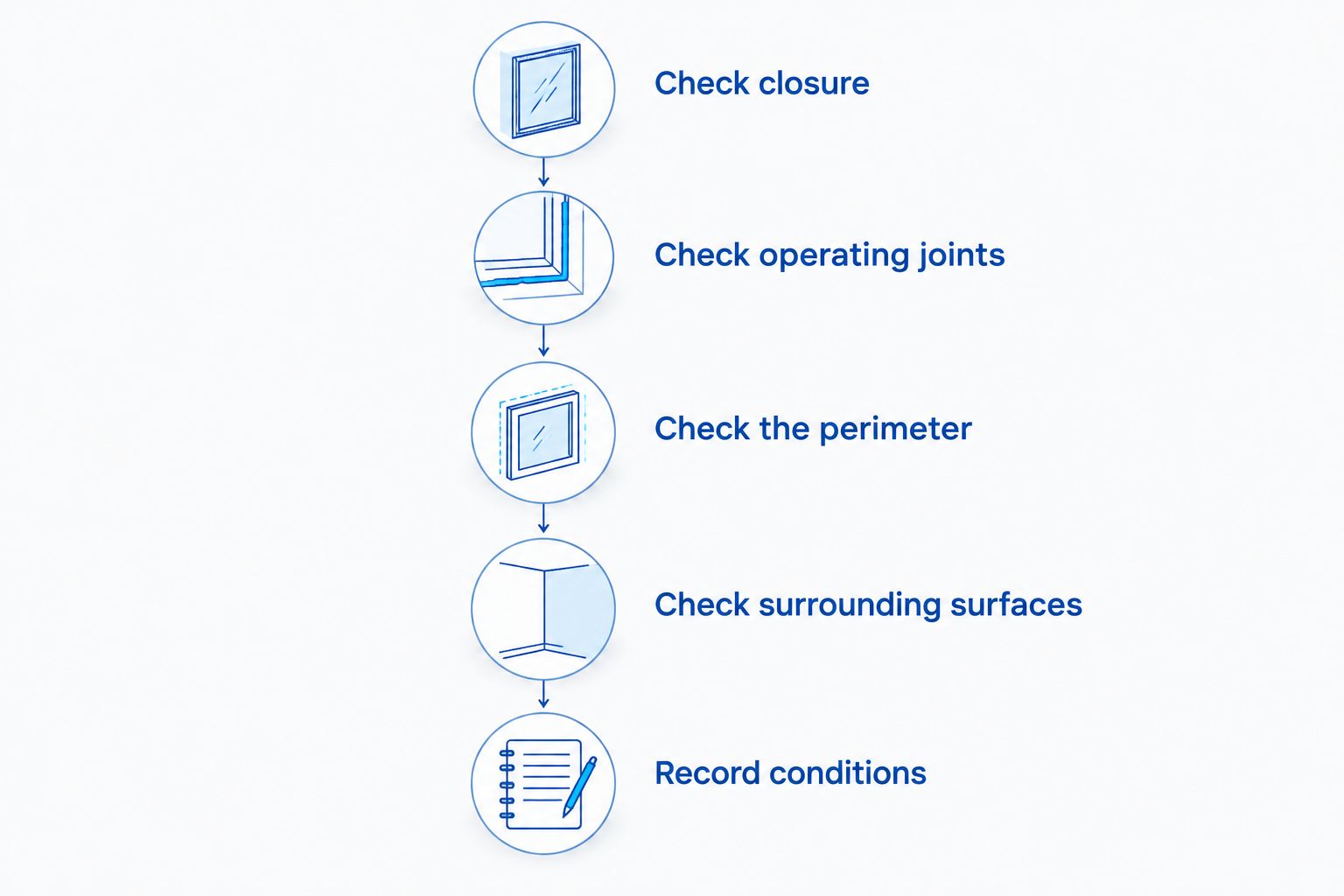
A tissue check is a screening step, not proof that an entire opening is sound. When the source remains unclear, ask whether a qualified professional should use blower-door testing or thermal imaging to investigate the building envelope.
What should you avoid during the inspection?
Do not use a candle or other open flame to trace air movement. Do not block window drainage openings, seal an operating sash shut, or cover moisture damage with caulk.
Exterior joints have different functions. Some must shed water or allow drainage, so indiscriminate sealing can create a new problem while hiding the original one.
When does repairing the existing window make sense?
Repair is the better starting point when the frame is sound and the defect is limited to a serviceable component. Examples include worn weatherstripping, a misaligned sash, or hardware that no longer closes the window tightly.
Ask whether compatible repair parts exist and whether the sash can return to proper alignment. A repair proposal should identify the failed component rather than describe the entire window as old.
The trade-off is scope. Replacing weatherstripping does not improve an underperforming glass assembly, and adjusting hardware does not repair concealed decay around the opening.
For a 2026 repair decision, separate the immediate draft complaint from other goals. Easier operation, different glazing, and changes to appearance are valid reasons to consider replacement, but they are not evidence that repair cannot stop the leak.
When does insert replacement make sense?
Insert replacement places a replacement unit within a retained frame. It is an option when the existing frame and surrounding conditions are suitable for that installation method.
An insert is best for a failed window inside an opening that does not need broader reconstruction. Retaining the frame can preserve more existing finishes, but it also limits what the contractor exposes during removal.
Ask how the retained frame will be inspected and how accessible perimeter gaps will be addressed. Also ask how the proposed unit changes the visible glass area and whether it affects required opening clearances.
The limitation matters most when you already have staining, unexplained leakage at the trim, or suspected deterioration. A proposal should explain how those concerns will be investigated rather than assume the insert will resolve them.
When is full-frame replacement the better approach?
Full-frame replacement removes the existing frame and exposes more of the rough opening. It is the stronger fit when inspection must reach damaged framing, failed perimeter connections, or water-management details hidden behind the old unit.
The benefit is access. The contractor can inspect exposed conditions and define repairs before completing the new installation.
The trade-off is disruption. Interior trim, exterior trim, siding connections, and finish restoration need explicit treatment in the scope; they should not become assumptions you discover after removal.
Full-frame replacement is not automatically necessary for every draft. Choose it because the opening requires access or correction, not because a broader demolition scope sounds more complete.
Why draft repairs and replacement results vary
The result depends on the condition of the whole opening, not just the replacement unit. These factors explain why similar-looking windows can need different work:
- Sash fit: A distorted or misaligned sash can leave operating joints open even when the window appears closed.
- Weatherstripping condition: Missing, compressed, or damaged seals change how tightly the moving parts meet.
- Frame-to-wall gaps: Air can travel around the frame behind the trim, separate from any leakage through the sash.
- Glass performance: Cold interior glass can create discomfort without a direct opening to outdoors.
- Water damage: Deteriorated framing or failed flashing changes the required work from a simple unit swap to an opening repair.
- House pressure: Exhaust equipment and leakage elsewhere in the house can affect where outdoor air enters.
These factors support a diagnosis; they do not establish a replacement scope by themselves. Ask the contractor to connect each recommended task to a condition observed at your home.
What belongs in a draft-focused window quote?
A useful 2026 window quote explains both the product and its connection to the house. A model description alone does not tell you how the installer will handle the opening.
Ask for written answers covering:
- Removal method: Insert replacement or full-frame removal, with the reason for that choice.
- Air sealing: Where the contractor will seal, what materials suit those joints, and how concealed gaps will be accessed.
- Water management: How flashing and exterior connections will direct water away without blocking drainage paths.
- Condition checks: What happens if removal reveals damaged wood, wet insulation, or other concealed defects.
- Finish restoration: Which trim, siding, painting, and interior repairs belong in the stated scope.
- Completion checks: How the contractor will check operation, locking, visible seals, and the original draft location.
For product comparisons, distinguish the NFRC U-factor from an air-leakage rating. U-factor describes heat transfer; it does not by itself tell you how much outdoor air passes through a window assembly.
A lower U-factor indicates less heat transfer under the rating conditions. Installation quality remains a separate question, so do not treat an efficient glass package as proof of a well-sealed opening.
Should window work be part of a larger remodel?
Coordinate window work with siding, interior wall changes, or an addition when the projects affect the same openings. This lets you decide trim, flashing, insulation, and finish responsibilities before separate scopes overlap.
For an addition or sunroom, start with how the space will be used and how it will connect to the existing house. The glazing, wall assembly, heating plan, and intended seasonal use belong in the same discussion.
Atozmn is best suited to Twin Cities owners seeking a remodeling consultation for connected home improvements. Ask the local firm to evaluate the broader project scope rather than assuming a window-only change will solve every comfort problem.
You can request a free consultation with notes about the draft location, visible damage, and any planned remodeling. Ask which inspection and trade responsibilities belong in the proposal.
Plan your remodeling scope
Discuss draft concerns, affected rooms, and related remodeling work in a free consultation.
Can new windows fix a room that still feels cold?
New windows can improve comfort when the existing windows are responsible for excessive heat transfer or leakage. They do not correct missing wall insulation, a poorly sealed floor connection, or inadequate heat delivery elsewhere in the room.
Describe the whole symptom: cold glass, moving air, a cold floor, or uneven room temperatures. That description helps prevent a window replacement proposal from becoming the default answer to an unrelated problem.
Does condensation mean I need replacement windows?
Condensation alone does not establish that you need replacement windows. Moisture on the room-side glass relates to surface temperature and indoor humidity; persistent moisture between panes of a sealed glass unit points to a different condition.
Ask where the moisture appears and whether the glass unit, sash, frame, or surrounding opening needs attention. Do not use fogging as proof of an air leak at the trim.
FAQ
Will replacing my windows stop every draft in my Minneapolis house?
No—window replacement stops drafts only when the work addresses their source. Air can also enter through surrounding walls, floor connections, and other openings that a window installation does not repair.
Can I fix a drafty window without replacing it?
Yes, a sound window can sometimes be repaired by correcting weatherstripping, hardware, sash alignment, or accessible perimeter gaps. The repair must match the actual defect and preserve drainage and operation.
Is full-frame replacement better than an insert for drafts?
Full-frame replacement is better when the opening needs inspection or repair beyond the retained frame. An insert remains an option when the existing frame is suitable and the proposal addresses the identified leakage.
Why do I feel cold air beside a window that is not leaking?
Cold glass can cool nearby indoor air, which then moves downward and feels like a draft. That sensation differs from outside air passing through a gap, so the diagnosis should distinguish the two.
What should I ask before accepting a window replacement quote?
Ask how the proposed installation will address the identified air path, including frame-perimeter sealing and any damaged materials. Confirm removal method, water-management details, finish restoration, and the process for concealed defects.
Can Atozmn help me discuss windows during a broader remodel?
Atozmn offers residential remodeling services in the Twin Cities and a free consultation. Bring your draft observations and related project plans, then confirm the window-specific scope and responsibilities during that discussion.
One last thing
Before signing a 2026 proposal, ask the contractor to point to the suspected air path and show where the written scope addresses it. If those do not match, clarify the work before choosing the window.
A better window and a corrected opening are separate requirements. The right project connects them without replacing sound components unnecessarily or leaving hidden defects untouched.
Related guides
- How to plan home additions in Minneapolis
- Can a sunroom home addition work year-round in Minnesota?
- How to phase a whole-home remodel in Minneapolis