Compare Minneapolis window replacement quotes by matching the installation method, window specifications, opening-by-opening scope, and finishing work before comparing the totals. A quote is not equivalent if it leaves out damaged framing, exterior flashing, interior trim, or disposal that another contractor includes. For your 2026 project, require written answers about exclusions, permits, and changes before you choose a contractor.
- For window replacement Minneapolis homeowners should compare matching installation scopes, not just quote totals.
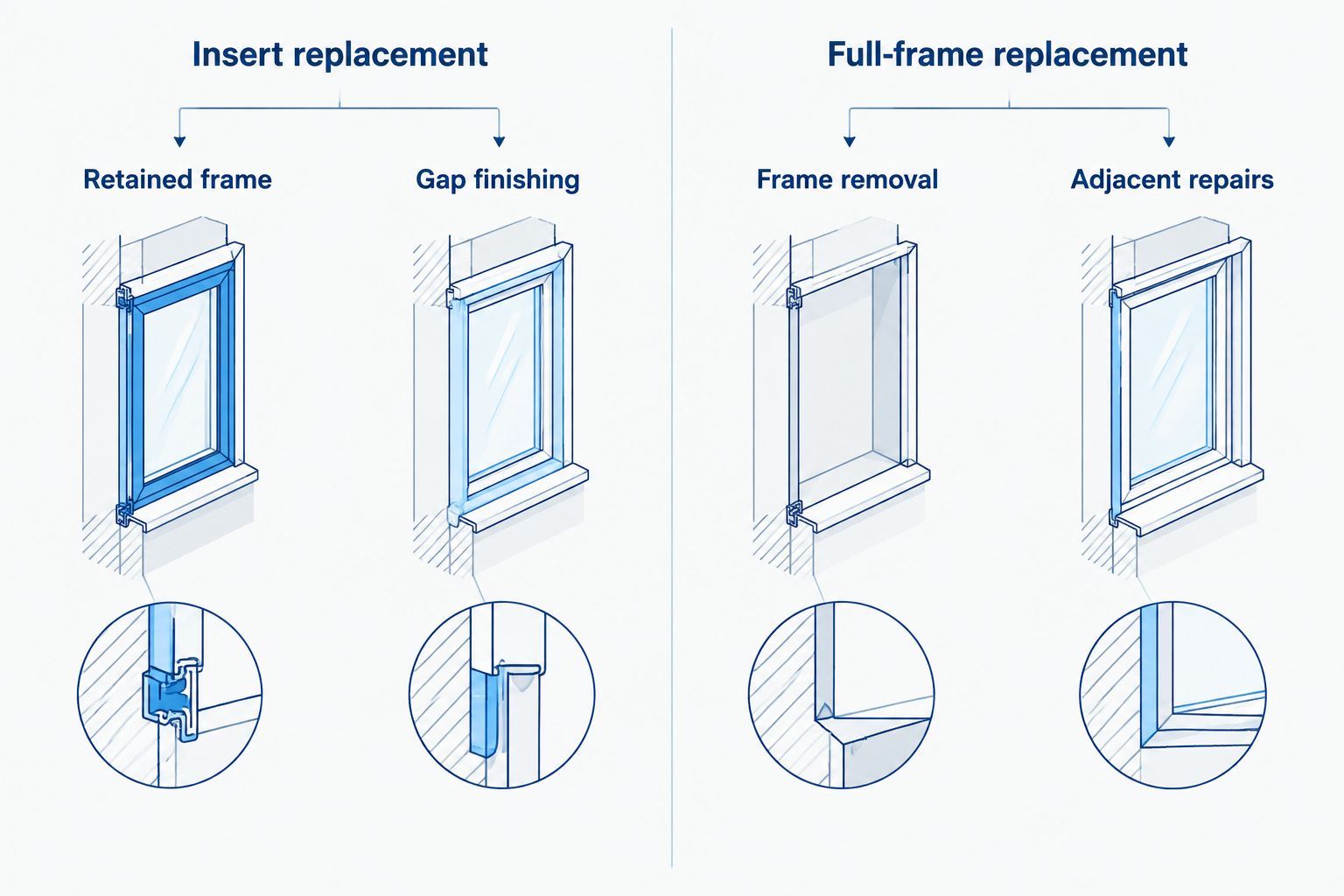
- Insert replacement retains the existing frame; full-frame replacement removes it and requires more surrounding finish work.
- Ask each contractor to identify flashing, insulation, trim, permits, disposal, and concealed-damage exclusions.
- Atozmn serves Twin Cities homeowners and businesses seeking remodeling services; discuss window work within your broader project.
How do you compare window replacement quotes in Minneapolis?
The strongest quote explains what happens at every opening, including what happens when the existing condition differs from expectations. Start with a common scope, then ask each contractor to revise the proposal against it. Comparing unlike installations does not tell you which contractor offers better value.
Use this sequence before signing:
- List the openings. Identify each window by room and location, including its operating style and any planned size changes.
- Confirm the installation method. Require the proposal to state insert replacement or full-frame replacement for each opening.
- Match the specifications. Compare the manufacturer, product line, frame material, glazing, operating style, and documented performance ratings.
- Define the surrounding work. Identify flashing, insulation, interior trim, exterior trim, siding repairs, and painting responsibilities.
- Resolve exclusions. Ask how the contractor handles concealed damage, permit responsibilities, debris removal, and owner-supplied work.
- Review the agreement. Check scheduling assumptions, payment milestones, written warranties, and the process for authorizing changes.
If window replacement is part of a larger remodel, use the contact page to request a quote or book the site's free consultation. Bring the opening list and your project goals rather than an unexplained total from another proposal.
Why this matters
A window quote covers both a manufactured unit and the construction work connecting it to your house. Matching the window model does not establish that the installation, water management, or finishing scope matches.
For a 2026 Minneapolis project, ask contractors to separate confirmed work from decisions that remain unresolved. A proposal that clearly identifies an unknown condition gives you a decision to make; a proposal that ignores it leaves the disagreement until construction.
This matters especially when you are also replacing siding, altering a wall, or planning an addition. Those projects share physical connections with the window opening, so the scopes need to agree about who completes each connection.
Insert replacement: retain the existing frame
Insert replacement installs a replacement unit within an existing window frame that remains in place. Best for: openings where the retained frame is suitable and you want to preserve surrounding finishes. Ask the contractor to explain how the existing frame's condition supports that recommendation.
The practical advantage is less disturbance to the surrounding construction. The limitation is equally important: the retained frame and portions of the existing connection remain outside the replacement work unless the proposal specifically includes repairs.
Ask whether the new assembly changes visible glass area and how interior and exterior gaps will be finished. Do not accept the word replacement as a complete description of the method.
Full-frame replacement: remove the existing frame
Full-frame replacement removes the existing window frame so the contractor can address the opening and install the new assembly. Best for: projects requiring frame removal, investigation of deterioration, or changes to the opening. The contractor should explain the extent of removal rather than treating full-frame as a complete scope by itself.
The advantage is access to the opening and surrounding connections. The trade-off is additional disruption to trim and adjacent finishes, which must be assigned in writing.
Neither method is automatically the right choice for every opening in a house. Ask for an opening-specific recommendation when conditions differ.
| Comparison point | Insert replacement | Full-frame replacement |
|---|---|---|
| Best for | Suitable retained frames and preservation of surrounding finishes | Frame removal, opening changes, or investigation of deterioration |
| Existing frame | Remains in place | Removed |
| Main advantage | Less disturbance to surrounding construction | Access to the opening and surrounding connections |
| Main limitation | Existing conditions remain partly concealed | More surrounding finish work needs definition |
| Quote detail to require | Retained-frame assessment and gap finishing | Removal limits, flashing, trim, and adjacent repairs |
The installation method determines which parts of the existing opening remain. Use that distinction to question the scope, not to choose a method without an assessment of your house.
What should the window specifications include?
Ask for an identifiable window specification, not a description such as energy-efficient vinyl window. The quote should let you verify what will be ordered and compare it with the other proposals.
Request these details in writing:
- Manufacturer and product line: Enough information to identify the proposed unit.
- Operating style: Fixed, casement, double-hung, or the specific style proposed for that opening.
- Frame and finish: Interior and exterior materials and finish selections.
- Glass configuration: The specified glazing package, including any required safety glazing.
- Performance documentation: Ratings for the proposed configuration, not an unrelated example.
- Included components: Screens, hardware, grilles, and other selected components.
For energy comparisons, the National Fenestration Rating Council's U-factor describes heat transfer; lower values indicate less heat transfer. Its solar heat gain coefficient describes admitted solar heat; lower values indicate less solar heat gain. Those ratings describe different properties, so do not treat them as interchangeable scores.
For your 2026 selection, compare the documentation supplied for the actual quoted configuration. A performance claim alone does not explain the installation scope, and a detailed installation scope does not identify the glass package.
Why window replacement scope varies
Quotes differ when contractors are proposing different work or making different assumptions. Before treating a difference as a reason to choose or reject a proposal, identify which of these factors explains it:
- Existing condition: Deteriorated frames, damaged sheathing, and signs of water entry require an assessment and a repair plan.
- Opening changes: A larger, smaller, or relocated opening changes the construction scope beyond swapping a window.
- Exterior connection: Siding, masonry, trim, and existing water-management details affect how the opening is accessed and finished.
- Interior finishing: Casing, jamb extensions, drywall repairs, and painting need clear ownership.
- Access and protection: Exterior access, interior furniture, landscaping, and occupied rooms affect the work plan.
- Related construction: Siding replacement, additions, and interior remodeling create connections that need coordinated responsibility.
Do not let an allowance or exclusion stand without an explanation. Ask what it covers, what triggers additional work, and how you approve that work before it proceeds.
How do you compare exclusions and concealed-damage terms?
An exclusion is acceptable only when you understand who completes the excluded work and how it affects the finished opening. For example, a proposal can identify painting as owner work, but you still need to know what surface the contractor leaves ready for painting.
Concealed damage needs a separate conversation. Ask what happens if removal reveals deteriorated framing or sheathing: who documents it, who recommends the repair, and how the contractor obtains your written authorization.
Use a scope worksheet with a row for each opening and columns for included work, excluded work, and unresolved decisions. Mark an unanswered item as unresolved rather than assuming it is included.
For your 2026 contract review, keep these questions attached to the proposal until the answers appear in the agreement. A verbal explanation is not a substitute for a written scope that both parties accept.
What changes when windows are part of an addition or sunroom?
When you are planning an addition or sunroom, compare the windows within the whole enclosure rather than as an isolated purchase. The foundation, wall assembly, roof connection, intended use, and heating plan belong in the same planning discussion.
Best for an addition project: one coordinated scope that assigns each construction connection. That approach makes responsibilities visible, but it also requires decisions about the larger project before window selections are final.
If your plans include added floor area, review how to plan home additions in Minneapolis before requesting a window-only proposal. Separate an existing-window replacement from new openings shown in addition plans so contractors are pricing the same work.
Atozmn is a fit for Twin Cities homeowners seeking a residential remodeling contractor. For an addition or sunroom discussion, ask how the proposed window work connects to the overall remodeling scope rather than assuming a particular window service or specification is included.
What should you verify before choosing a local contractor?
Evaluate a local remodeling firm on the documented scope and its ability to answer questions about your property. A nearby address alone does not establish who handles permits, installation, supervision, or follow-up.
Ask the contractor to identify the contracting business, explain any applicable license requirements, and provide insurance documentation for review. Confirm permit responsibilities with the contractor and the relevant local building department; do not assume every replacement scenario follows the same process.
Request the actual warranty documents and distinguish the window manufacturer's terms from any installation warranty. Then check who receives a service request and which party evaluates a concern involving the connection between the window and the building.
Before signing, confirm:
- Who measures and approves the final order.
- Who protects interiors and landscaping.
- Who supervises installation and answers questions.
- Who removes debris and completes trim repairs.
- Who documents unfinished work at the final walkthrough.
Atozmn provides residential and commercial remodeling in the Twin Cities metro. Bring the same written checklist to that conversation as you bring to every other contractor discussion.
Discuss your remodeling scope
Bring your window list and addition or renovation plans to a free consultation.
Should you choose the quote with fewer exclusions?
Choose the quote with the clearest complete scope for your project, not simply the shortest exclusion list. A specific exclusion can be more useful than an undefined promise to include everything.
Require the final proposal to identify who completes each necessary task. If you plan to handle painting yourself, for example, define the contractor's preparation work and the condition of the surfaces at handoff.
Can you compare quotes with different window brands?
You can compare different window brands when you align the operating style, materials, glass configuration, documented ratings, and installation scope. Brand names alone do not establish equivalent products.
Keep product differences separate from labor differences. Otherwise, you cannot tell whether a proposal changes the window itself, the construction work, or both.
FAQ
What’s the best way to compare window replacement quotes in Minneapolis?
Compare the same openings, installation method, window specifications, and finishing responsibilities. Ask each contractor to resolve exclusions in writing before you choose.
Is full-frame replacement better than insert replacement?
Full-frame replacement is not automatically better than insert replacement. Full-frame work removes the existing frame; insert replacement retains it, so the existing condition and project goals determine the appropriate scope.
Should a window replacement quote include interior trim?
A window replacement quote should state whether interior trim is retained, replaced, repaired, or excluded. It should also assign responsibility for jamb extensions, drywall repairs, and painting where those tasks are needed.
How do I know whether permits are included?
The proposal should identify who checks permit requirements and who obtains any required permits. Confirm requirements for your specific project with the relevant local building department.
What happens if the installer finds damaged framing?
The agreement should explain how concealed damage is documented and how you authorize repairs. Ask for a written change process before removal begins.
Can I compare window quotes while planning a sunroom?
Compare sunroom windows as part of the complete enclosure and intended use. Keep existing-window replacements separate from new openings so each proposal describes the same construction.
What should I bring to a remodeling consultation?
Bring an opening-by-opening window list, photos of visible concerns, your existing quotes, and any addition or renovation plans. Identify decisions that remain open rather than filling the gaps with assumptions.
One last thing
Before signing your 2026 agreement, ask the contractor to describe what each opening will look like at handoff: inside trim, exterior trim, sealant, surrounding finishes, and cleanup. That question turns a vague promise of completion into a practical acceptance checklist.
Choose a defined finished condition, not just a window model. An identifiable product matters, but the proposal must also explain how the contractor leaves your house when the work is done.
Related guides
- Can a sunroom home addition work year-round in Minnesota?
- What belongs in a Minneapolis roof replacement estimate?
- How do you phase a whole-home remodel in Minneapolis?