A Minneapolis roof replacement estimate should identify the roof areas, removal work, materials, flashing, ventilation, disposal, permit responsibility, payment terms, and how concealed damage will be handled. For a 2026 project, require written exclusions and a change-order process so the quoted scope does not leave you guessing when the old roofing comes off.
- For roofing Minneapolis projects, compare written scopes before comparing totals.
- Require named materials, flashing details, ventilation work, and a concealed-damage approval process.
- Atozmn serves Twin Cities owners seeking roofing and other residential or commercial remodeling services.
- Separate roof replacement work from gutters, siding repairs, and storm-damage insurance decisions.
Why this matters
A roof replacement estimate is a description of what you are buying, not just a total at the bottom of a page. If removal, flashing, or deck repairs remain undefined, you cannot tell whether competing contractors are quoting the same job.
For a 2026 Twin Cities project, bring roof photos, known leak locations, and any plans for an addition or sunroom to your consultation. You can request a free consultation to discuss the proposed work before deciding which scope to approve.
What belongs in a Minneapolis roof replacement estimate?
A complete estimate connects each roof area to specific work, materials, responsibilities, and exclusions. Use this checklist to review the document with the contractor, then ask for revisions wherever the answer exists only in conversation.
| Estimate item | What the document should explain | Question to resolve |
|---|---|---|
| Roof areas | Which house, garage, porch, or addition roofs are included | Are any attached or detached areas excluded? |
| Removal | Existing roofing and components scheduled for removal | What stays in place? |
| Deck condition | Inspection and repair process after removal | Who approves concealed-damage work? |
| Roofing materials | Manufacturer, product, underlayment, and selected finish | Are substitutions allowed without approval? |
| Water-management details | Eaves, valleys, edges, penetrations, and wall intersections | Which flashing is replaced or retained? |
| Ventilation | Existing conditions and proposed intake or exhaust work | Is ventilation being changed or left alone? |
| Site protection | Access, debris handling, cleanup, and property protection | Who handles damage caused during the work? |
| Administration | Permit responsibility, scheduling, payment, and written terms | What must happen before work starts? |
Start with roof areas and removal
Ask the contractor to name every included roof area. A house roof, attached garage, porch, and detached garage are not interchangeable descriptions, even when they appear on the same property.
The estimate should distinguish roof replacement from patching or work limited to a particular slope. Mark excluded areas on a sketch or photo if written descriptions leave room for disagreement.
Removal needs its own explanation. Ask what existing roofing will come off, which accessories will be removed, and how debris will leave the property. Do not assume that replacing the roof covering also means replacing every metal detail beneath or beside it.
Name the roof assembly, not just the visible covering
The visible roofing material is only part of the scope. Underlayment, edge details, flashing, and roof penetrations also need written treatment.
For a shingle roof, request the manufacturer and product identification rather than a description such as architectural shingles alone. Ask the contractor to identify the applicable installation requirements and explain any proposed substitutions before you sign.
Keep material selection separate from performance promises. A product name does not establish how the roof will be installed, what the contractor covers, or which conditions a manufacturer requires for its written warranty.
How should flashing and roof intersections be described?
An estimate should say which flashing will be replaced, which will remain, and how retained flashing will be evaluated. Look for details around chimneys, plumbing vents, skylights, valleys, and roof-to-wall intersections wherever those features exist on your building.
A line reading flashing as needed leaves the decision undefined. Ask what condition triggers replacement and whether the associated work is included or requires separate approval.
| Flashing approach | Best for | Benefit | Limitation |
|---|---|---|---|
| Replace identified flashing | Owners seeking a defined replacement scope | Makes the planned work explicit | Can require related siding or masonry work that needs separate description |
| Retain inspected flashing | Situations where the contractor documents suitability | Avoids removing components solely because adjacent roofing changes | Depends on condition and compatibility; retention needs a written explanation |
| Decide after exposure | Details that cannot be fully inspected beforehand | Allows decisions based on visible conditions | Leaves scope unresolved until removal, so approval terms matter |
These are scope approaches, not interchangeable promises of performance. Ask the contractor to explain the proposed approach for each relevant location rather than accepting a single blanket statement.
If you are planning a home addition or sunroom, identify the future roof connection now. The replacement estimate should state whether it addresses only the existing building or includes any work associated with the planned addition.
What should happen if the roof deck is damaged?
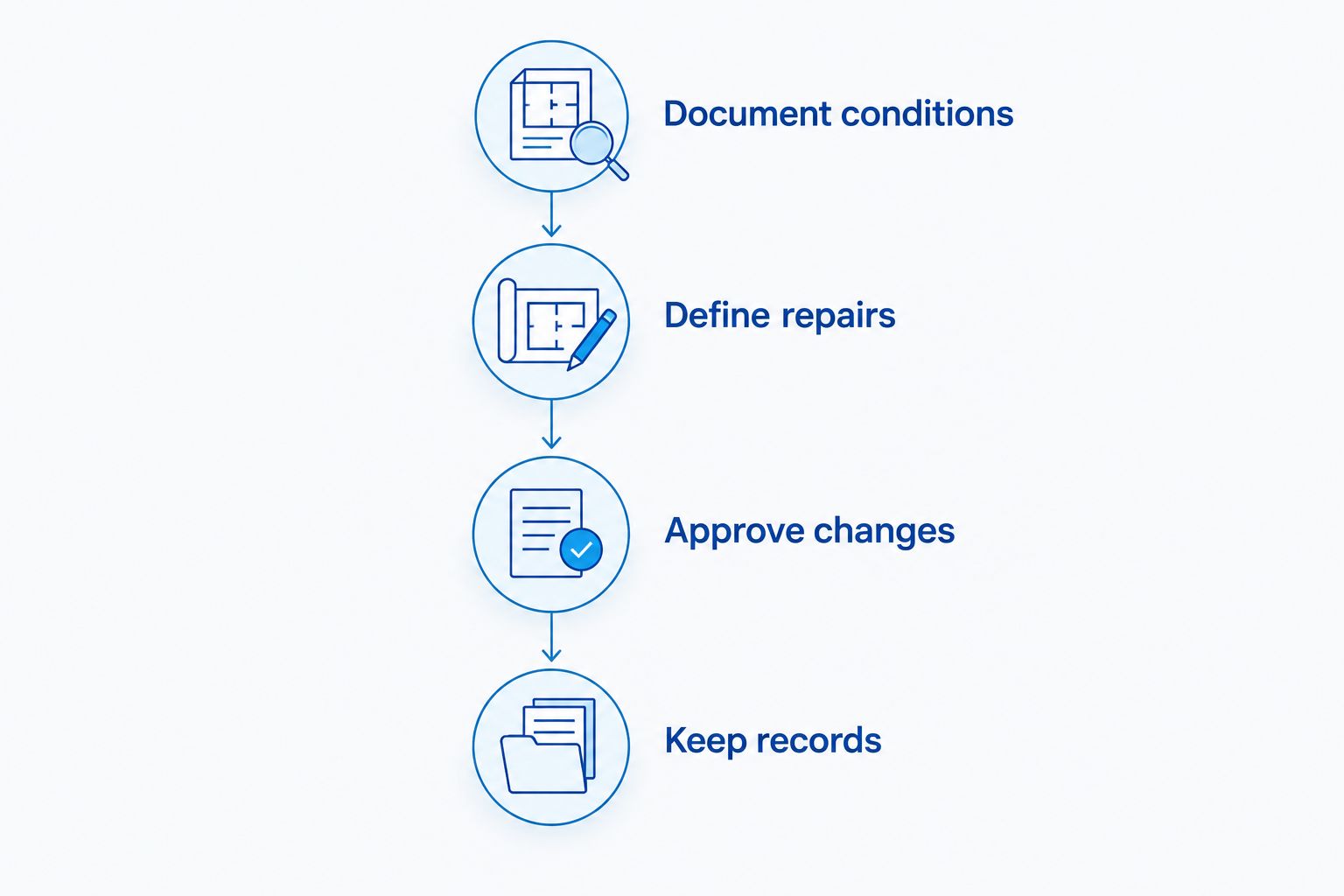
Concealed deck damage needs a written decision process before removal begins. The estimate should explain how the contractor documents the condition, proposes a repair, obtains approval, and records the resulting scope change.
Use this sequence when reviewing that process:
- Document conditions. Request photos and a description of the exposed problem.
- Define repairs. Ask what material will be removed and what will replace it.
- Approve changes. Require written authorization under the contract’s change-order terms.
- Keep records. Retain the approved change with the estimate and completion documents.
A pre-removal inspection cannot expose every concealed condition. The contract should distinguish known repairs already included from concealed work that requires a later decision.
Ask how the contractor will protect exposed areas while awaiting authorization. Do not leave temporary weather protection or communication responsibility to an informal understanding.
Why roof replacement scope varies
Roof replacement estimates differ because buildings and proposed work differ. These factors explain scope differences without treating every higher or lower total as evidence of better value:
- Roof configuration: Valleys, dormers, steep sections, and intersecting roof areas require different access and detailing.
- Existing assembly: Removal plans depend on what is already installed and what the contractor proposes to retain.
- Deck condition: Visible concerns and concealed damage require different levels of certainty in the initial scope.
- Water-management details: Chimneys, skylights, wall intersections, and penetrations need location-specific treatment.
- Ventilation scope: Replacing roof covering does not automatically resolve attic intake, exhaust, or moisture concerns.
- Connected work: Gutters, siding, masonry, an addition, or a sunroom can introduce separate responsibilities and exclusions.
For a 2026 estimate comparison, ask each bidder to describe these conditions using the same roof areas and project assumptions. That gives you a consistent basis for deciding what is included.
Who handles permits, protection, and scheduling?
The estimate or accompanying contract should identify responsibility for applicable permits, inspections, and closeout documents. Confirm current requirements with Minneapolis for your specific project rather than relying on an assumption about another property.
Ask who obtains the permit, who coordinates inspections, and what documentation you receive at completion. If those duties belong to the owner, the written agreement should say so.
Site protection also deserves specific language. Discuss landscaping, windows, siding, outdoor equipment, driveway access, and the route used to move materials and debris.
For an occupied commercial property, explain tenant access and business operations before accepting the scope. For a home, identify parking constraints, pets, and areas that must remain accessible.
A 2026 start discussion should separate the proposed work window from a guaranteed completion commitment. Ask how weather interruptions, material changes, and concealed repairs affect scheduling and how updates will reach you.
How do you compare roof replacement estimates fairly?
Compare the scope before treating the totals as competing offers. Put the estimates side by side and mark differences in removal, materials, flashing, deck repairs, ventilation, cleanup, and exclusions.
Request revisions when a contractor’s proposal leaves out a decision another contractor has already defined. A verbal explanation helps you understand the job; a revised written scope establishes what you are being asked to approve.
Keep these documents together:
- The estimate: The proposed work and its stated assumptions.
- The contract: The agreement governing authorization, payment, changes, and responsibilities.
- The product documents: Installation requirements and applicable written manufacturer terms.
Ask who will manage the work and who can authorize changes. Evaluate a local firm by its explanation of your actual roof conditions, its written scope, and the responsibilities it accepts—not by a broad claim about craftsmanship.
Atozmn is best suited to Twin Cities owners seeking roofing within a broader remodeling scope. That service range is relevant when roof work intersects with siding, storm damage restoration, or other planned construction; it does not replace the need for a detailed roof-specific agreement.
Request a roof replacement consultation
Discuss roof areas, connected remodeling work, and the scope you need in writing.
Should gutters and siding be included in the roof estimate?
Gutters and siding belong in the estimate when the contractor is proposing work on them. Otherwise, the exclusions should make clear that roof replacement does not include their repair or replacement.
Roof-edge and wall-intersection work can involve adjacent materials. Ask whether the contractor expects to remove or disturb those materials and who restores them afterward.
For an addition or sunroom, resolve the connection between new and existing construction before approving overlapping scopes. Separate contractors should not leave you responsible for discovering a gap between their agreements.
Is a storm-damage estimate the same as a replacement contract?
A storm-damage assessment, an insurer’s scope, and a contractor’s agreement serve different purposes. Your replacement agreement should state the work you authorize, regardless of how an insurance document organizes the damage.
Ask the contractor to identify differences between the proposed construction scope and the insurer’s paperwork. Direct coverage questions to the insurer, and do not treat a contractor’s repair recommendation as a coverage decision.
Keep photos, correspondence, approved changes, and construction documents together. The goal is a clear record of both the damage discussion and the work you actually approved.
FAQ
What should I look for in a roofing Minneapolis estimate?
A roofing Minneapolis estimate should identify included roof areas, removal, materials, flashing, ventilation, site protection, permit responsibility, and exclusions. Require written terms for concealed repairs and scope changes.
Should my roof replacement estimate include plywood replacement?
Your roof replacement estimate should explain how damaged roof decking will be evaluated and repaired, rather than assuming every panel needs replacement. Known repairs should be distinguished from concealed conditions requiring later approval.
Does a new roof automatically include new flashing?
A new roof does not establish that every flashing component is included for replacement. Ask the contractor to identify which flashing will be replaced, retained after inspection, or evaluated after exposure.
Should I accept a roof estimate that only lists a total?
Request a detailed written scope before accepting a roof estimate that only lists a total. Without defined materials, responsibilities, and exclusions, you cannot compare the proposed work reliably.
Can I combine roof replacement with a home addition?
You can plan roof replacement and a home addition together, but the agreements need to define the connection between existing and new construction. Ask who handles temporary protection, flashing, drainage, and any work excluded from either scope.
Who should confirm Minneapolis roof permit requirements?
Confirm applicable requirements with Minneapolis and require the contractor’s agreement to assign permit and inspection responsibilities. Do not assume the permit is included because the estimate describes a complete replacement.
Can I discuss other remodeling work during a roofing consultation?
Atozmn provides roofing and other residential and commercial remodeling services in the Twin Cities. Use the consultation to identify connected work, then request separate scope details wherever responsibilities or project phases differ.
One last thing
Before signing your 2026 roof replacement agreement, ask the contractor to walk through the roof-to-wall connections—not just the open roof surfaces. Every transition needs a stated plan, especially where an existing roof meets a planned addition or sunroom.
If the explanation changes your understanding of the job, have the estimate revised. The document you sign should match the project you expect.
Related guides
- How to plan home additions in Minneapolis
- Can a sunroom home addition work year-round in Minnesota?
- How to compare bathroom remodeling quotes in Minneapolis